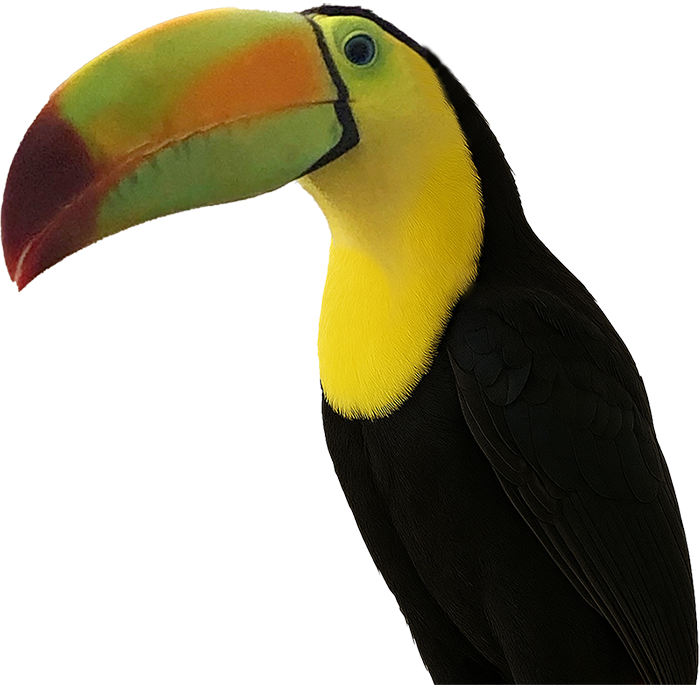
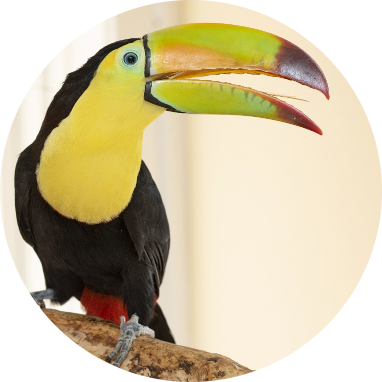
Not just a pet, she’s a rainbow-feathered family member with flair.
A Chicago toucan with a San Diego soul
Lucy was born in June 2019 in San Diego and flew to Chicago (via Delta Cargo) for her new home in 2020. She became not only a pet, but a member of our family. Through much training, feeding, and playing, we witnessed that Lucy was highly intelligent and possessed untapped potential. She loves flying and jumping from branch-to-branch and exploring within her habitat. Lucy is highly curious, which speaks to her intelligence. She loves head scratches and landing on peoples’ arms.
The keel-billed toucan (Ramphastos sulfuratus), also known as the rainbow-billed toucan, is a strikingly colorful bird found in the tropical forests of Central and South America. This species is best known for its large, vividly multicolored bill, which has made it an iconic bird in both wildlife conservation and popular culture. As the national bird of Belize, the keel-billed toucan plays an important role in rainforest ecosystems.
The keel-billed toucan
Physical Characteristics
The keel-billed toucan measures 42–55 cm (16.5 to 21.5 inches) long, with a colorful 15 cm bill made of lightweight, hollow bone. Its vibrant bill shows green, orange, red, and blue, while its body is mostly black with yellow, blue, and red accents.
(Source: National Geographic)
Adaptations of the Bill
Despite its size, the oversized bill serves many roles: reaching fruit on distant branches, releasing excess body heat, and enabling social behavior like playful “bill-fencing,” which toucans use for communication, defense, and establishing bonds within their groups.
(Source: National Geographic)
Habitat and Distribution
Found in lowland rainforests from Mexico to Venezuela, keel-billed toucans prefer canopy life up to 1,900 meters (6,200 ft). Social by nature, they travel in small flocks. Though populations are declining from habitat loss, they remain classified as Least Concern.
(Source: IUCN Red List)
Diet and Feeding Behavior
Primarily frugivorous, keel-billed toucans also eat insects, lizards, eggs, and small birds. Their varied diet supports adaptability. By dispersing seeds through droppings, they help sustain tropical rainforest ecosystems, contributing to plant diversity and forest regeneration across their native habitat.
(Source: Rainforest Alliance)
Reproduction and Lifespan
Keel-billed toucans nest in tree cavities, laying 1–4 eggs. Both parents incubate and feed the blind, featherless chicks. Young stay in the nest for 8–9 weeks. In the wild, toucans may live up to 20 years.
(Source: Animal Diversity Web)
Behavior and Social Structure
Social and playful, keel-billed toucans engage in bill-dueling to bond and establish hierarchy. Their croaking calls aid communication in dense forests. At night, several toucans roost together in tree cavities, bills tucked under wings to conserve heat and space.
(Source: Cornell Lab of Ornithology)
Conservation Status and Threats
Though listed as Least Concern, keel-billed toucans face threats from deforestation, illegal pet trade, and climate change. Conservation efforts include protecting habitats and supporting eco-tourism programs that encourage sustainable rainforest management and raise awareness of the species’ ecological importance.
(Source: World Wildlife Fund (WWF))
Support Lucy fuel the feathers, feed the flow
Your donation helps keep Lucy inspired and the jazz flowing — one squawk at a time.